SCORM Talk vs. SCORM Walk
Categories: e-Learning Atlas, Ideas and Thoughts, SCORM 2004, SCORM 2004, SCORM Cloud, SCORM Cloud
13 Dec 2011
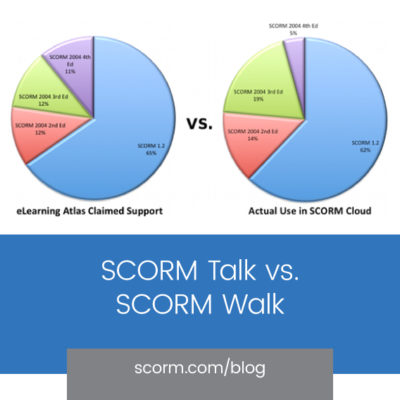
When looking through the eLearning Atlas, I wondered if the versions of SCORM that companies claim to support are closely matched to what we see being used in reality, via SCORM Cloud. Let’s check it out:
Versions of Claimed SCORM Support in the eLearning Atlas vs. Use in SCORM Cloud:

1 Comment | Post a comment »
eLearning Atlas: Research Worth Sharing
Categories: AICC, e-Learning Atlas, SCORM, SCORM 2004, SCORM 2004
5 Dec 2011
We created the eLearning Atlas to be an ideal tool to easily find the proper solutions. Jena and I have tried to speak to every company in the Atlas, and we continue to seek those that we’ve missed. This process provides a valuable pool of data. Rather than hoard this information, I thought it would be nice to share.
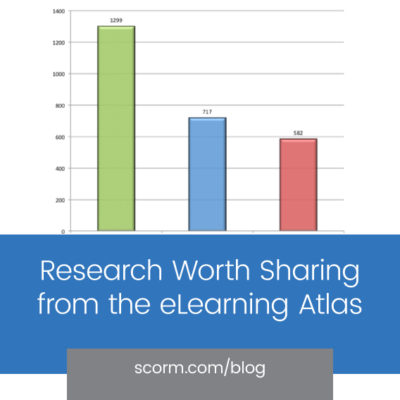
Let’s take a graphical look at some of the interesting conclusions I’ve drawn. The following graphs only include traditional products that can implement standards (Authoring Tools, LMSs, LCMSs and Content Libraries). Here we can see the haves and the have-nots:
eLearning Atlas Products That Support At Least One Standard:

A look at the Haves:

So, what does this all mean? For the majority of the industry, SCORM works, but there are lots of eLearning products out there that don’t play nicely with one another. The creation and delivery of content is a hard problem to solve, without a common standard or model… it’s really hard to solve.
When developers try to fit a unique course into a unique learning system… things get complicated. When eLearning gets complicated, things get expensive.
The eLearning Atlas proves that there are thousands of possible companies who can create, manage and deliver eLearning, some doing it without any claimed support for standardization. For some companies, the expense of stepping outside their branded box of solutions, locks a customer in for life. We think SCORM frees people to choose the best fit. The eLearning Atlas can help users easily filter out the noise of companies who are not interested in playing nicely with one another, and make connections with products that want to work together.
To look at it another way, we’ve currently found 219 Authoring Tools, some being used by 360 Custom Content Creators to make training that will be delivered using 655 LMS/LCMSs… that’s 51,640,200 possible combinations. Trying to fit all those pieces together, each time, is a daunting task and the exact pain ADL created SCORM to solve. SCORM (and other standards) help eLearning providers play nicely with one another; the eLearning Atlas can help users find the products and services that will play nicely with the systems they already use.
No Comments | Post a comment »
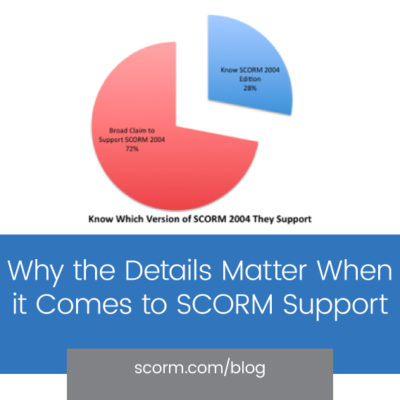
A car salesman’s credibility is quickly lost when he guesses what size engine is under the hood or what the gas mileage could be. Claiming a car has “good” gas mileage is not the same thing as knowing it’s 40 mpg. A 6-cylinder engine can come in a variety of flavors… in-line or V, turbocharged or naturally-aspirated, these details create some machines that are much faster than others. With cars, more is not always better, sweating the details creates vehicles that keep “car guys” debating for hours. People who care nothing for cars will make generalizations that make me cringe, but nobody wants a guessing salesman to help choose the perfect vehicle.
3 Comments | Post a comment »
The best company you can have, in a strange place, is a map.
-MacGyver
I’ve seen every episode of MacGyver… most more than twice. When thinking about the best way for users to get what they want out of our eLearning Atlas, MacGyver’s advice came to mind.
No Comments | Post a comment »
Facebook + SCORM Cloud
Categories: Ideas and Thoughts, SCORM Cloud, SCORM Cloud, Software Development
26 Sep 2011
We get asked all the time, “What is an LMS?” So, here’s a challenge… express it as simply, as elementally as you can. Here’s my effort:
A tool that authenticates students, connects them to a topic, as well as each other, and provides the tools to efficiently deliver, track and assess the learning process.
- (Think you can do it better using only 140 characters? Step up and leave a comment…)
We’ve been pondering different applications and how they apply to that definition. And I can’t stop coming back to Facebook as a great candidate for an LMS of the future.